Night weaning from a bottle
Weaning night feeds from a bottle has one clear advantage over doing it at the breast: you can see exactly how much is going in, which makes the taper measurable rather than approximate.
3 min read
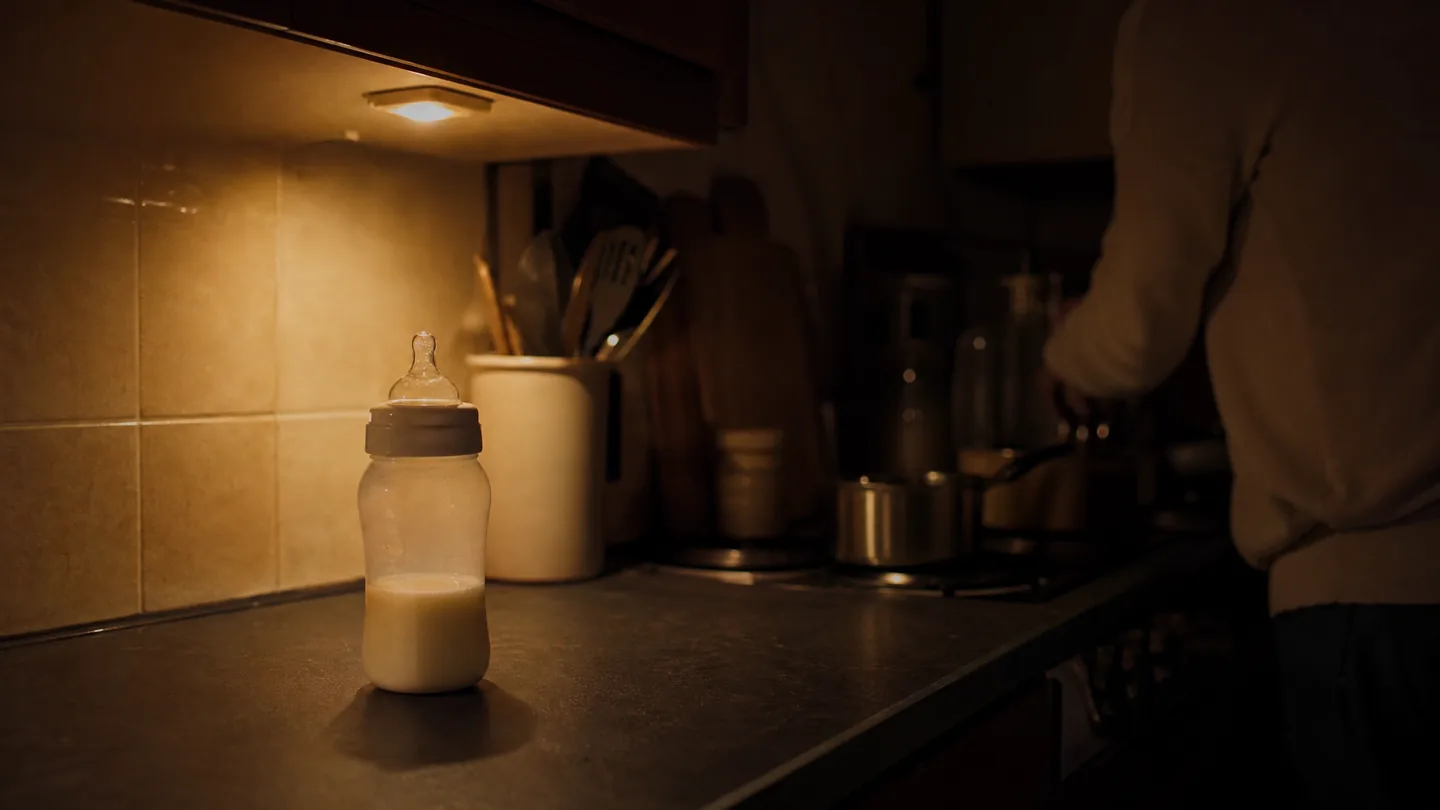
Because volume is visible, you can reduce by a fixed amount on a fixed schedule and know precisely where you are. That removes most of the guesswork, and it lets you go slowly enough that your baby barely registers each step.
The same preconditions apply as for any night weaning: daytime intake up first, no illness or teething in progress, and a baby who is growing well.
The taper
Increase daytime feeds for a week first. The calories have to go somewhere. This step is the one most often skipped and it is the one that makes the rest work.
Reduce one feed by 20 to 30ml every two nights. One feed at a time, starting with the one closest to morning.
Drop it at around 30ml. Below that it is not doing nutritional work, and offering a token bottle mostly maintains the habit.
Then move to the next feed. Expect the whole sequence to take two to three weeks for two feeds.
Replace it with comfort. A cuddle, a hand, the same words. And where possible, the parent who does not usually do the bottle.
Two things not to do
Do not water down formula as a weaning method. Diluting formula reduces the nutrition your baby receives and, done substantially, can be dangerous. Reducing the volume of correctly made formula is the safe equivalent and achieves the same thing.
And do not put your baby down with a bottle, at any age. It is a choking risk, and prolonged contact between milk and teeth overnight is a significant cause of early tooth decay. If a bottle is given at night, it should be given while held and finished before they go down.
Reduce the volume, never the concentration. Watered-down formula is not a smaller feed - it is a worse one.
What to watch
Daytime intake should rise as night intake falls. If it does not over a week or two, pause the taper and let the daytime catch up. Wet nappies, mood and weight are the practical indicators.
Once your baby is over a year and on cow’s milk, night bottles are worth phasing out for dental reasons regardless, and water can be offered instead if they wake thirsty.
What to do about the wake that remains
Removing the bottle does not automatically remove the wake. Plenty of babies continue to surface at the old feeding time for a week or two afterwards, out of habit rather than hunger, and how you respond decides whether that fades.
Settle them the same way every time, with the least help that works, in the dark, without a bottle. Water is an option past a year if they genuinely seem thirsty, though offered every night it simply becomes the new bottle. Most of these residual wakes disappear within a fortnight if the response stays consistent and dull.
After a year
Once your child is over twelve months and on cow’s milk, night bottles are worth phasing out for dental reasons regardless of whether sleep is a problem. Milk pooling around teeth overnight is one of the more common causes of early decay.
If they genuinely wake thirsty, water in a cup is the replacement rather than a smaller bottle of milk. And bottles generally are worth moving away from around a year, which makes this a sensible moment to do both at once rather than removing the night bottle and keeping the daytime ones.
When to stop troubleshooting
Do not reduce feeds in a baby under six months, one who is not gaining weight well, or one who is unwell, without speaking to your health visitor or GP. Persistent hunger, falling daytime intake or weight loss all mean stopping and getting advice.
Want this worked out for your baby instead?
The quiz takes three minutes and asks about your nights, not just their age.
Take the 3-min quiz →General guidance, not medical advice. Your paediatrician's advice takes precedence.