Gradual retreat, step by step
You are willing to be in the room, and you want to end up not being. Gradual retreat is the most reliable way to get from one to the other, and the only way to get it wrong is to hurry.
4 min read
The principle is that you stay present while your baby learns to fall asleep, and then reduce your presence in increments small enough that no single step is a shock. Over three to five weeks you move from beside the cot to outside the door.
It works because at every stage your baby is falling asleep in their cot, by themselves, with you nearby. The skill is being built from night one; what changes is only how much of you is in the room.
The steps
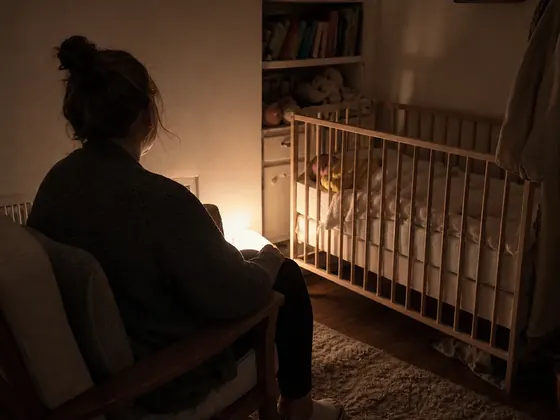
1. Beside the cot, hand on them. Put them down awake, hand resting still on the chest or back, quiet reassurance. Stay until asleep.
2. Beside the cot, no hand. Same chair, same position, voice only. This step is often the hardest of the whole sequence.
3. Halfway across the room. Sitting, visible, responding with voice. Move the chair a metre at a time if the whole distance is too much.
4. By the door, inside the room. Still visible, still audible, mostly quiet.
5. Just outside, door open. Answering only if they escalate. Then, after a few nights, leaving.
How long on each step
Three to four nights minimum, and only move on when the current step is genuinely working - settling within about fifteen minutes without significant protest, two or three nights running. Moving early is the commonest mistake and it usually costs a week.
If a step goes badly for three nights, go back one and stay there longer. Retreating a step is not failure; it is the method functioning as designed.
Never move to the next step because a week has passed. Move because this one is working.
Making it work
Get the timing right before you start - a method applied at the wrong bedtime will not work regardless. Do bedtime first and leave night wakes alone entirely until bedtime is settled; night wakes usually improve on their own once it is.
Be boring while you are in the room. No eye contact games, no conversation, minimal response. Your presence is the reassurance; anything more becomes entertainment. And both parents should use the same step on the same nights, or your baby is running two experiments at once.
Expect setbacks during teeth, illness and travel. Go back a step or two, and expect to move through them faster the second time.
What to do when they wake at night
Leave the night wakes alone for the first two or three weeks. Settle them however you normally would - feed, rock, lift, whatever works - while the bedtime work goes on separately. It feels inconsistent and it is not: bedtime is where the learning happens, and the middle of the night is where you get to morning.
A good proportion of night wakes resolve on their own once bedtime settles, because a baby who falls asleep in the cot at seven can generally do the same thing at two. If some remain after bedtime is solid, take them one at a time, starting with the one closest to morning, and apply the step you are currently on at bedtime.
Being boring in the room
The most common way this goes wrong is that the parent in the room becomes interesting. Eye contact, conversation, responding to every noise, standing up and sitting down - all of it gives a baby something to engage with at the exact moment you want them disengaging.
Sit still, look at the floor rather than the cot, say the same short phrase occasionally and nothing else. Take a book if it helps you stay put. The point of your presence is reassurance that you exist, and it works better the less it offers beyond that.
When to stop troubleshooting
Pause during illness and resume afterwards. If several weeks produce no progress at all, check wake windows and bedtime before changing method - and speak to your health visitor if there is snoring, pauses in breathing, or distress that does not settle with your presence.
Want this worked out for your baby instead?
The quiz takes three minutes and asks about your nights, not just their age.
Take the 3-min quiz →General guidance, not medical advice. Your paediatrician's advice takes precedence.