What self-settling actually means
The phrase arrives loaded. For most people it conjures a baby crying alone in a dark room. That is not what it describes, and the actual meaning is far less dramatic.
4 min read

Self-settling is the ability to move from awake to asleep without needing something applied from outside - without being fed, rocked or held to the point of unconsciousness. That is all it means. It says nothing about whether anyone is in the room, and nothing about crying.
It matters because of what happens at cycle boundaries. A baby who can get themselves to sleep at bedtime can generally do the same thing at two in the morning, and their night looks like fewer wakes even though the surfacings are just as frequent. That is the whole of the mechanism.
What it looks like in practice
A baby put down awake who goes to sleep. They may chat, wriggle, grumble, suck their fingers and roll about for fifteen minutes first. All of that is self-settling in progress.
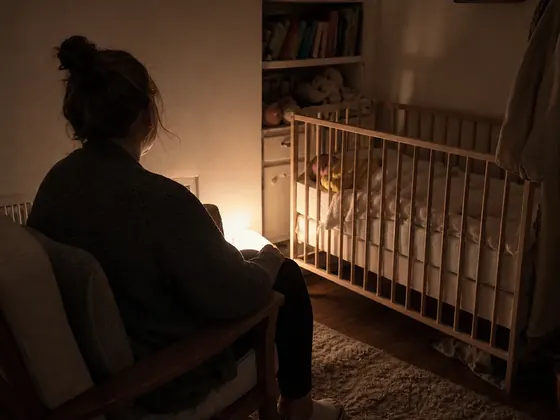
A parent may well be in the room. Sitting beside the cot with a hand on their chest, every night, is entirely compatible with a baby who self-settles.
It is not silent. Grumbling and noisy resettling are how it sounds. Expecting silence is what leads people to intervene too early.
It is not all-or-nothing. Most babies do it sometimes, at some sleeps, before they do it consistently.
When it develops
Not before around four months, and not reliably for a good while after. The neurological capacity to regulate arousal develops gradually across the first year and beyond. A newborn cannot self-settle in any meaningful sense, and expecting it produces nothing but frustration.
From around four to six months most babies can begin to, given the opportunity. Given the opportunity is the operative phrase: a baby who is always asleep before they reach the cot never gets to practise.
It is a skill that needs practice, and practice means being put down awake often enough to have a go.
How to give them the chance
Once a day, at the sleep where it is easiest - usually bedtime, sometimes the first nap - put them down drowsy but genuinely awake, and stay. Offer whatever help they need. What you are changing is not the amount of support; it is where the final transition into sleep happens.
Some babies take to it in a week. Some take months. Some are still being helped to sleep at eighteen months and are entirely well. There is no deadline, and there is no evidence that a baby who does not self-settle by a particular age suffers for it.
What it is not
It is not sleeping through the night - those are different things and a baby can do one without the other. It is not being left alone. It is not silence. And it is not a permanent state: babies who self-settle reliably at seven months frequently stop during teething, illness and developmental leaps, and start again afterwards.
It is also not a requirement. Nothing bad happens to a baby who is helped to sleep for two years, and there is no evidence of any developmental cost. The reason to work on it is practical - it is the mechanism that reduces night waking - and if your nights are survivable without it, there is no reason to.
The link to night waking
This is the whole reason it matters. Every baby surfaces at the end of every sleep cycle, several times a night, whether or not they can self-settle. What differs is what happens next: a baby who can get themselves to sleep generally sinks back without anyone noticing, and a baby who cannot needs the same help they needed at bedtime.
That means the number of night wakes you experience is largely decided at bedtime rather than at two in the morning. It also means working on the middle of the night directly is usually the hardest possible route to the result - bedtime is where the same skill is learned in far easier conditions.
When to stop troubleshooting
If a baby who could previously settle suddenly cannot, look for illness, teething or a developmental change before technique. Persistent inability to settle at any time, alongside distress, poor weight gain or unusual irritability, is worth raising with your health visitor.
Want this worked out for your baby instead?
The quiz takes three minutes and asks about your nights, not just their age.
Take the 3-min quiz →General guidance, not medical advice. Your paediatrician's advice takes precedence.