Responsive settling: staying in the room
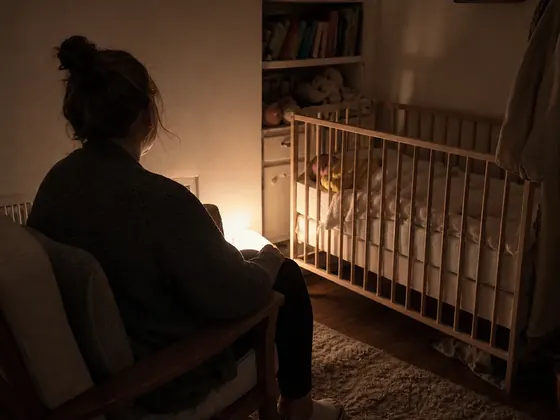
You are not willing to leave the room, and you do not have to. Presence is a perfectly good baseline to work from - provided you reduce what you do while you are there.
3 min read

The thing that changes a baby’s night is not whether a parent is in the room. It is whether the baby makes the final transition into sleep themselves. Those two are entirely separable, and a great deal of unnecessary anguish comes from treating them as the same question.
So you can stay. What has to reduce is your level of participation, from doing the settling to accompanying it.
The levels of participation
1. Doing it for them. Rocking, feeding or holding to sleep. Your baby arrives asleep.
2. Active soothing in the cot. Patting, shushing, rhythmic touch. They are in the cot; you are still doing the work.
3. Still contact. A hand resting, not moving. Present but no longer rhythmic.
4. Voice only. A few words, occasionally. Nearby, visible, hands off.
5. Present and quiet. In the room, doing nothing. This is the destination, and it is a legitimate place to stop.
The trap
The failure mode of this approach is staying at level two indefinitely - an hour of patting every night, for months, with no reduction. Your presence has become the sleep condition, and now you cannot leave the room until they are fully asleep, at bedtime and at every wake.
The way to avoid it is to make the reduction deliberate and scheduled. Decide in advance that you will move down a level every four or five nights, and write down which level you are on. Without that, it drifts, and a fortnight becomes six months.
Staying in the room is fine. Doing the same amount in it every night for six months is the problem.
Where to stop
Level five is a good destination and there is no requirement to go further. Plenty of families sit quietly in the room at bedtime for years and have entirely normal nights, because the baby is falling asleep by themselves with someone nearby.
If you do want to leave eventually, gradual retreat continues from here - moving the chair further out over several weeks. But that is optional, and it can wait until it suits you.
Keeping track of where you are
Write down which level you are on and the date you moved to it. This sounds excessive and it is the difference between a six-week process and a six-month one, because without it the reduction simply stops happening. Everyone means to move down a level next week, and next week is a bad week, and then it is March.
A note on the fridge saying “level three since the 8th” takes five seconds and gives you something to check against. It also matters when two adults are involved: both need to be on the same level on the same nights, or your baby is being run through two different experiments in parallel.
Whether to leave at all
You do not have to. A parent sitting quietly in the room while a baby falls asleep by themselves is a stable, sustainable arrangement, and plenty of families keep it for years without any problem at night.
The thing worth checking is what it costs you. If bedtime takes fifteen minutes and you would be sitting down anyway, nothing. If it takes an hour, or means one of you is unavailable every evening, or means nobody else can put them to bed, those are real costs and worth weighing. The answer is a household decision rather than a developmental requirement.
When to stop troubleshooting
Pause during illness or teething and resume afterwards. If reducing participation consistently produces significant distress at every level, or if a baby cannot settle even with full presence, that is worth discussing with your health visitor.
Want this worked out for your baby instead?
The quiz takes three minutes and asks about your nights, not just their age.
Take the 3-min quiz →General guidance, not medical advice. Your paediatrician's advice takes precedence.